Insurance Renewal LINE Bot PM Case Study
B2B tool PM practice | PRD assumption validation and requirement recalibration
A renewal-management system for a small Taiwanese property-insurance brokerage office. The focus is not only the final PRD, but the key recalibration step and the reasoning behind it.
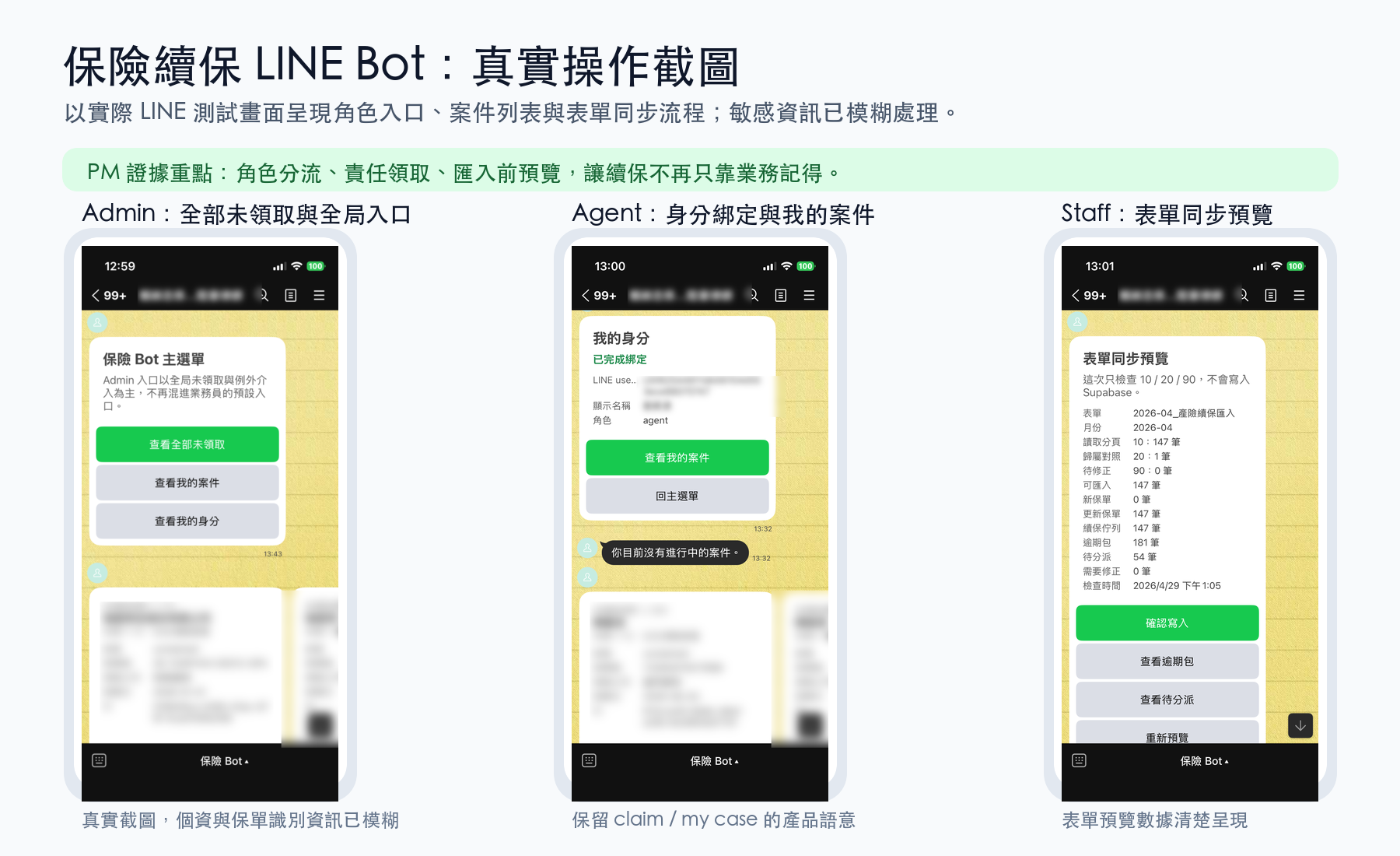
Admin global entry, Agent claim flow, and Staff sheet-sync preview with sensitive information blurred. This is evidence that the responsibility-flow design can actually run.
The problem that triggered this project
We often just skim the email and register the policy, then something gets missed. We had a policyholder whose agent did not proactively follow up, and the customer also missed the insurer's notice. The property-insurance policy lapsed, and it became a complaint.
From an interview with a small brokerage-office owner
Insurance renewals theoretically have two notification lines: the insurer notifies the policyholder before expiration, and the broker agent should proactively contact the customer. In practice, both lines can fail: the agent does not follow up, and the policyholder ignores the insurer's SMS, email, or paper notice. The policy truly lapses. At best it becomes a complaint; at worst, a claim during the lapse period cannot be paid.
This is not an occasional mistake. It puts responsibility on two unreliable human links: "the agent remembers" and "the policyholder notices." I judged this to be a common small-office pattern worth solving with a system.
Why this small market was worth doing
Competitive landscape and the gap I saw
| Competitor / position | Characteristics | Limitation for small offices |
|---|---|---|
| PIRANS renewal helper | LINE Bot plus Google Sheets, positioned as an individual-agent tool. | Validated willingness to pay, but has no team collaboration mechanism. |
| Franchise brokerage back offices | Systems from major brokerage networks are feature-rich. | Designed for headquarters managing branches, not for collaboration inside one small office. |
| Gap I saw | Turn 'contact window → staff → agent → customer' into enforced responsibility flow. | Fill the space between PIRANS and franchise systems. |
This case is not about the final PRD alone. It is about the key self-correction in the middle: how I treated PRD v1.0 as a hypothesis, then used The Mom Test-style interviews to reposition the product from a renewal reminder tool into a responsibility-flow system.